Saturday, 19 April 2014

The Amazing Spider-man 2

You could say it all boils down to release dates. The Amazing Spider-man, the much maligned yet surprisingly enjoyable reboot that featured a wall-crawler truer to the comics, was released in June 2012, just five years after Tobey Maguire hung up his webs and called it a day. With The Amazing Spider-man 2 opening not even a full two years after the last instalment, you’d be forgiven for questioning whether Sony and Columbia Pictures are being a bit precipitous with the Spiderman franchise.

You wouldn’t be wrong, for what we have here is a shiny-looking blockbuster with an astonishingly clunky plot that feels disjointed and unfocused, the key signs of a film that was rushed into production, the script a mere afterthought. The fact that Shailene Woodley’s scenes as pending love interest Mary Jane Watson were shot and subsequently cut from the film only adds further validity to this theory. With the pace never truly picking up, TAS2 can often prove to be quite a laborious viewing experience.

For starters, Roberto Orci and Alex Kurtzman’s already crowded screenplay dedicates far too much time to Peter Parker’s parents’ death, a mystery which was never a big concern in the comic books and that only bogs down the film’s lengthy running time. Secondly, director Mark Webb’s insistence on having his central couple Peter and Gwen Stacy caught up in a never-ending game of break-up/make-up is also perplexing, especially as it seemed like he’d surmounted that issue in the closing scenes of the previous film. Throw in the decision to populate the movie with multiple villains, and suddenly you realise you’ve got quite a bit of material to cover in 140 minutes.

Speaking of which, there are also a few glaring missteps in the portrayal of the villains, especially Jamie Foxx’s Electro, who the posters and trailers reliably inform us is the main big bad. His human alter-ego, Max Dillon – a sad, forgotten loner longing for attention – is an interesting proposition, someone that should creep us out and elicit our sympathy in equal measure, but for some reason Foxx plays the role for laughs. Post-transformation, he’s a blue-skinned, gravelly-voiced nutter with the power to shoot electrical discharges. Pure eye candy, granted, and he’s also at the centre of the film’s more memorable action sequences, but it also means that Electro feels more like an end level boss, rather than a fully rounded character. And as for Paul Giamatti’s Russian mobster Rhino… what a waste of a good actor and comic book character.     

Dane DeHaan’s Harry Osborn on the other hand, is a far more intriguing villain. Financially privileged but despised by his dying father and colleagues, he could’ve easily ended up as a spoilt rich kid caricature, but thanks to DeHaan’s jittery performance, he comes off instead as a plausibly disturbed young man dealing with a plethora of insecurities. And while his issues fittingly culminate in a horrific transformation into the Green Goblin, his sudden urge to don a battle suit, not to mention his dexterity at surfing a flying glider, is rather baffling.

Mind you, it’s not that TAS2 gets everything wrong – in fact, there are a few neat touches that ensure it’s not a complete failure. The web-swinging sequences are getting more inventive (although with the constant developments in CGI, that’s to be expected) and are brought to life both by 3D vision and Hans Zimmer’s sumptuous score (but we could’ve done without the dubstep in the Electro sequences). The chemistry between real life couple Andrew Garfield and Emma Stone is still a joy to watch, which also means that TAS2 will go down well as a first date movie. And while the third act momentarily steers proceedings into much darker territory, Mark Webb is smart to enough to realise that, unlike Batman, Spidey is a character that thrives out of the shadows and ends the film on a reassuringly upbeat note.

At the centre of all this well-intentioned confusion is Garfield (the actor, not the cat), who once again proves that, while Sam Raimi may have directed better Spider-man films, Webb undeniably has the better Spider-man. Witty, charming and unapologetically verbose, he manages to embody the true essence of the character from the comics. More crucially, he has not yet done a Saturday Night Fever strut down the street à la Spider-man 3. Here’s hoping that, with bit more time at disposal and a better script at hand, The Amazing Spider-man 3 won’t go down that route too.


2/5  

Sunday, 13 April 2014

The LEGO Movie

It could’ve so easily ended up as a 100 minute toy ad – which, if we want to be cynical, it kind of still is. Instead, high concept masters Phil Lord and Chris Miller have pulled off one hell of a hat trick and turned The LEGO Movie into a visually inspired comedy that also has a beating heart underneath all those plastic bricks. True, the irreverent humour often borders dangerously on chaotic and adult viewers are likely to figure out the twist early on, but you sure can’t deny its emotional punch. As long as Lord and Miller are directing, can we also have Hungry Hungry Hippos movie, please?

3/5

Saturday, 29 March 2014

Captain America: The Winter Soldier

Despite playing not a small part in the almighty success of The Avengers back in 2012, there seems to be a recurring opinion among film audiences that Captain America is the most boring of Marvel’s superhero bunch. Lacking the distinctive powers of his teammates and dressed up in the American flag, it’s not difficult to see why he’d be dismissed as a jaded US allegory, but that would be an unfair assumption. The truth is Cap is a character that’s very easy to get wrong. However, stick him in the right context (preferably, one in which he is at odds with current socio-political events rather than being defined by them) and he instantly becomes a far more compelling proposition. Thankfully, that just happens to be the case with The Winter Soldier.

It’s been two years since Earth’s mightiest heroes disassembled and man out of time Steve Rogers (Chris Evans, always watchable and evidently more comfortable in his red, white & blue skin) is adjusting to life in the 21st century, all while working as a highly effective covert agent for S.H.I.E.L.D., often alongside fellow Avenger Natasha Romanoff (Scarlett Johansson). But Rogers is increasingly uncomfortable with the secret organisation’s Orwellian methods, going so far to accuse director Nick Fury (Samuel L. Jackson) of “holding a gun to everyone on Earth and calling it protection”. When terrorists appear to be attacking S.H.I.E.L.D. from the inside, including a bionically enhanced ghost agent known as the Winter Soldier, it is up to a rogue Captain America to identify the perpetrators and restore order.

The problem with The First Avenger was that, despite an enjoyable first half in which the Captain’s origin was effectively handled, the rest of the film was marred by uninspiring combat montages and a camp sci-fi flair that jarred with the WWII setting. It was almost as if screenwriters Christopher Markus and Stephen McFeely felt that turning in a script featuring Nazi villains would’ve been too politically incorrect, a creative license that did not prove detrimental to the Indiana Jones movies, which were clearly a source of inspiration. In stark contrast, for The Winter Soldier the writers have not shied away from tackling topics that we are confronted with on the evening news, such as cyber-terrorism, wire-tapping and information leakage, making this sequel the most socially relevant Marvel movie to date.

Directorial duo the Russo Bros. (whose previous high-profile gigs are restricted to, surprisingly, Welcome to Collinwood and You, Me & Dupree) have also made the impressive choice to limit the CGI set-pieces to a minimum and instead opt for well-choreographed action sequences more akin to what we’ve seen in 90’s classics Speed, Heat and Ronin, or the more recent Bourne trilogy. The claustrophobic scene in which Cap takes out an elevator full of assailants (“Before we get started, does anyone want to get out?”) is the stand-out of an impressive assortment, while Nick Fury’s messy car chase on the streets of Washington DC comes a close second. By keeping proceedings grounded, the action feels more brutal and believable. In comparison, the gargantuan final set-piece above three airborne helicarriers may get the adrenaline pumping, but admittedly feels slightly out of place with what came before.

TWS may officially be a solo outing, but Steve Rogers has nonetheless surrounded himself with another team of heroes, each one helping to bring the film to vibrant life. Scarlet Johansson gets to add more layers to the Black Widow, now officially the most rounded female character in the superhero genre (shame the same can’t be said about Cobie Smulders’ Maria Hill, who barely features this time round), while Samuel L. Jackson turns in a more vulnerable performance as the enigmatic Nick Fury. However, it is Anthony Mackie who steals the show as Sam Wilson, aka The Falcon, a forgettable C-list character in the comics that’s been brilliantly adapted for the big-screen – it’ll be hard for you not to cheer him on as he straps on those mechanical wings and takes to the skies. As for the titular Winter Soldier, he feels admittedly a little underdeveloped, but remains nevertheless a threatening presence and a visually striking villain.

Factor in the filmmakers’ decision to avoid the OTT comedy that ran a little too rampant in Thor: The Dark World and you have a confident superhero flick that also functions as an astute political thriller. For that reason, Captain America: The Winter Soldier is the most mature and quite possibly the best in Marvel’s Phase Two set of movies.

And while we’re at it, make sure you stick around for the obligatory mid-credits sequence at the end of the movie which, considering certain character rights difficulties going on between 20th Century Fox and Marvel, may well be the ballsiest PR stunt the latter studio has pulled off to date.


4/5 

Saturday, 22 March 2014

Labor Day

You might not want to watch Labor Day on an empty stomach. This is a film ripe with frames of mouth-watering food, with one meticulously shot baking scene even playing an integral part in character development. It’s a hot Labor Day weekend and Frank (Josh Brolin) wants to teach single mum Adele (Kate Winslet) and her son Henry (Gattlin Griffith) how to make a decent crust for a peach pie. As they get to work on mixing the dough with no utensils, Frank and Adele’s hands end up delicately intertwining and an evident connection begins to form between the two. Except Frank is no ordinary man. In fact, he happens to be an escaped convict who is lying low in this small family’s home while the police relentlessly patrol the area.

Based on the novel by Joyce Maynard, Labor Day marks quite a departure from director Jason Reitman’s previous work. In all of his films from Thank You For Smoking to Young Adult, he’s always managed to put a comical spin on controversial characters (whether they are tobacco lobbyists or self-centered home-wreckers) that has always been carefully calibrated, which in turn made his protagonists more human and relatable despite their obvious flaws. In stark contrast, Labor Day is largely a humorless affair, which makes accepting a taciturn one-time murderer as a romantic lead/loving father figure slightly more problematic. It’s an intriguing challenge Reitman has set himself, just arguably one he does not manage to live up to.

Still, you can’t fault him for trying. What we have here is a filmmaker straying out of his comfort zone and eager to venture into new territories – except it seems that Reitman has inadvertently stumbled into Steven Spielberg’s back yard. Labor Day’s warm photography and 80’s rural setting could very easily have been lifted from Amblin Entertainment’s early back catalogue, while the fact that the film is narrated from the perspective of a prepubescent Henry makes this a coming of age tale as much as a suburban thriller. Therefore, while the scenes focusing on young Hank’s emerging infatuation for girls are endearingly portrayed, the ones in which Frank teaches him how to change a car tyre and throw a baseball like a man are probably a tad too syrupy.

If anything, the performances are reliably solid. Kate Winslet proves she is fast becoming the new Meryl Streep and that her Golden Globe nomination earlier this year was fully deserved, thanks to her believable portrayal of a vulnerable mother who’s forgotten what it is like to be loved. As implied earlier, Josh Brolin has to contend with the trickier role and while at times Frank may come off a little too holier-than-thou, Brolin manages to infuse him with enough warmth and charisma to make him a character you want to root for.

In true Spielbergian fashion all loose ends are tied up a little too neatly towards the end, especially after what is admittedly a gut-wrenching climax. It’s a pity, really, as Reitman is not usually one to give into narrative catharsis. After all, George Clooney didn’t get the girl at the end of Up in the Air and Charlize Theron didn’t learn a damn thing by the end of Young Adult. Perhaps for once the director was yearning for a happy ending. Let him have it.


3/5

Wednesday, 26 February 2014

The Great Beauty

There’s a lot of beauty to appreciate in Paolo Sorrentino’s La Grande Bellezza. The director clearly has a keen eye for classic sculptures and the female form, both of which he captures majestically in between breathtaking shots of Rome. Meanwhile, Toni Servillo further cements his position as Italy’s most authoritative actor, his Jep Gambardella a suave yet unfulfilled writer who has a passion for lavish parties that would give Jay Gatsby a run for his money. It’s just a shame that the film never picks up momentum – what we have here is a handful of powerful scenes and magnetic characters in search of a coherent narrative to hold them all together.

3/5


Sunday, 9 February 2014

12 Years a Slave

Despite its challenging subject matter – or rather, because of it – 12 Years a Slave could so easily be dismissed as the sort of contrived, emotionally manipulative film specifically designed to woo the Oscar crowd. You know the type: rousing war epics, political dramas making defiant left field statements, biopics about controversial characters wrestling with their inner demons in the form of drug/alcohol addictions and, especially, Holocaust movies, which have become something of a punchline since that episode of Ricky Gervais’ film-set sitcom, Extras (“I've noticed that whenever you do a film about the Holocaust – guaranteed Oscar!”).

But while we’ve been exposed to the horrors of WWII and Jewish persecution on a fairly regular basis, the same cannot be said about the enslavement of African Americans throughout the 17th, 18th and 19th centuries in the United States, a dark chapter in the country’s history which hasn’t been tackled on-screen with the frequency it deserves. 15 minutes into Steve McQueen’s film, the reason will become obvious.

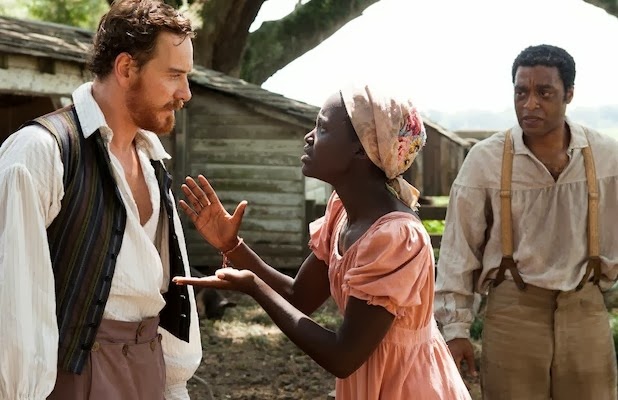
12 Years a Slave tells the true story of freeman Solomon Northup (Chiwetel Ejiofor), a talented violinist living with his family in Saratoga, New York who is lured to Washington with the promise of work, only to find himself captured and sold into slavery in Louisiana. Here he will endure 12 years of subjugation and all sorts of racial abuse at the hands of plantation owners and slave drivers, especially the tyrannical Edwin Epps (Michael Fassbender).

A Hollywood director could’ve mishandled 12 Years… by saddling it with heavy-handed moral lessons about equality and brotherhood (the only time we come close to this is with the brief appearance of Brad Pitt’s abolitionist carpenter, a character a little too angelic to be entirely believable), but British filmmaker Steve McQueen instead is bold enough to go down a darker route. He’s already proven with Hunger and Shame that he adopts an uncompromising approach towards the topics he confronts and therefore doesn’t flinch away from portraying the hardships of slavery that go beyond the “N” word and long hours spent in the plantation fields. Men and women are stripped and paraded for prospective owners to inspect, a mother is separated from her children with no sign of remorse whatsoever (“Your children will soon enough be forgotten”) and a foreman sings racist songs in a horribly misguided attempt to alleviate working conditions (Oh run nigger run well the pattyroller will get you/Run nigger run well you better get away). The audience doesn’t need a character to address what’s right and wrong for them – the material speaks itself.

It helps that our conduit into this oppressive world is Chiwetel Ejiofor, who infuses Solomon with the humanity and sincere emotion required to get us through such a brutal journey. An actor who throughout the past decade has excelled in small but memorable roles, it is immensely gratifying to see Ejiofor rise to leading man status and hold his own against some of Hollywood’s most exciting talents, including Pitt, Paul Giamatti, Benedict Cumberbatch and regular McQueen collaborator Michael Fassbender, who terrifies as ruthless yet self-loathing plantation owner Edwin Epps. But also worthy of mention is newcomer Lupita Nyong'o, who turns in a disarmingly committed performance as Patsey, a young slave who also happens to be the object of Epps’ affections. The scene in which the latter has her tied to a post and whipped to within an inch of her life before the helpless gazes of the other slaves makes for distressing viewing and will most likely be the scene that will remain with you long after the credits roll.

Like the horrific marks on the characters’ backs, 12 Years A Slave is a brutal yet necessary history lesson that will scar and move in equal measure. And considering the impressive number of Academy Award nominations it has stacked up, consider the Oscar crowd wooed.


5/5 

Sunday, 19 January 2014

The Wolf of Wall Street

"My name is Jordan Belfort. The year I turned 26, I made $49 million, which really pissed me off because it was three shy of a million a week." As far as opening lines go, you’re not likely to come across a better one in 2014 – it grabs your attention, raises a chuckle and makes for an economic introduction to the film’s insatiable protagonist. It also functions as a forewarning that we’re in for three hours of wild excess and moral decadence beautifully orchestrated by Martin Scorsese. When taken on those terms, The Wolf of Wall Street truly is a fascinating beast.

When we first meet Jordan Belfort (Leonardo DiCaprio), he is a wide-eyed wannabe yuppie eager to get rich the quick way via the wonders of stock brokerage. All it takes is one meal with a Wall Street hot shot for Jordan to realise the prospects this new world offers – “The name of the game: move the money from your client’s pocket into your pocket” crows Matthew McConaughey’s smarmy Mark Hanna, before adding that the secret to doing this job is hookers and cocaine. And just like that, Belfort’s fate is sealed.

What follows is a movie chronicling one man’s meteoric rise to power, as we witness Jordan go into business, build an empire of ruthless stockbrokers, manipulate the finance market to his every need and blow the money on a lifestyle almost too depraved to describe. Not even 30 minutes into the film, we’re already treated to office orgies, chimps on skates, midget throwing contests, breast implant auctions, naked marching bands and a relentless consumption of class A drugs, all of which were allegedly common occurrences at Belfort’s brokerage house, Stratton Oakmont.

Herein lays the biggest issue with TWOWS. For a film about stock brokers getting rich off the losses of their unsuspecting clients, no light is shed on the misery of the latter and far too much time is instead dedicated to the pleasure-seeking lifestyles of the former. By all means, viewers shouldn’t be lectured to and not every movie needs to come bow-wrapped in a moral, but considering we’re still dealing with the impact that the 2008 financial crisis has had on the global economy, a little more discretion on Scorsese’s behalf wouldn’t have been out of place.

Not that the director lets his characters completely off the hook, mind. If there’s one thing TWOWS does very well is reveal how an overabundance of riches and power will bring out the worst in us. Predictably, Jordan’s combined addiction to sex and drugs takes a gradual turn for the ugly, and while his colleagues come from humble origins, the moment the dosh comes piling in their laps (sometimes literally), they turn into insufferable fraudsters with giant egos. An early scene sees an office worker allowing her hair to be shaved in public and agreeing to undergo plastic surgery – all for a few thousand cash. The look on her face as her locks are clumsily removed is one of regret and humiliation barely concealed by weak laughter. It’s a quietly powerful moment in an otherwise OTT scene.

Yet despite the subtext about corruption, there’s no getting away from the fact that TWOWS is the funniest film Marty’s ever made (not to mention his raunchiest – he’s definitely never dedicated so much attention to pubic landscaping). Freeze frames and slow-motion are employed to brilliant comedic effect, while some characters reveal a Scrubsian inner monologue that adds hilarity to scenes already funny in their own right. As for the star of the show, Leonardo DiCaprio is something of a revelation. For someone who excels in dramatic roles and often comes across as a bit of a bore in the media, it’s a joy to see him this unhinged. His chemistry with regular funnyman Jonah Hill is evident, their banter rapidfire and instantly quotable (“I will NOT die sober!”), while the scene in which Jordan tries to drive his sports car under the effect of Qualuudes will have you in stitches. Who’d have thought Jack Dawson would turn out to be such a talented physical comedian?

Finally, the overlong running time does occasionally stretch patience and you’ll probably feel guilty for enjoying these characters’ company so much, but don’t let that get in the way of a damn good movie. Three hours of sex, laughs and hardcore drugs all wrapped up in a thick wad of cash, delivered by one of Hollywood’s most esteemed directors. How’s that for a recommendation?

4/5