Sunday, 16 November 2014

Interstellar

In the not too distant future, the inhabitants of planet Earth are faced with an alarming shortage of food and resources, while an increasing number of sandstorms threaten to make life even more unsustainable. In a bid to find a new world that the human race can make their home, a small team of astronauts board NASA’s last remaining spaceship and set off on a pioneering mission, as they try to explore a new galaxy via a mysterious wormhole.

Ever been in the presence of someone who got so caught up in explaining a theory they had just stumbled upon, that they lost you halfway through their earnest monologue overflowing with scientific jargon? That’s a big fat metaphor that aptly summarises Interstellar, one of the smartest blockbusters to ever grace our screens yet also an unexpectedly dissatisfying movie-going experience.

You certainly can’t fault the Nolan brothers (Christopher directing, his brother Jonathan penning the screenplay) for a lack of effort. From the moment Michael Caine and Anne Hathaway’s scientists launch into detailed explanations on wormholes, binary coordinates and gravitational waves, it becomes clear the two filmmakers have done their homework. Problem is, they probably got into it a little too much. It’s never a good sign when characters in science fiction films need to explain a convoluted narrative with the aid of a whiteboard (Emmett Brown’s timeline diagram in Back To The Future Part II being the rare exception) - Interstellar resorts to this device not once, but three times, clearly suggesting that the Nolans have bitten off more than they can chew.

That’s not to say that Interstellar should’ve been dumbed down – if anything, it’s got the opposite problem of the Transformers movies, which could do with more brains to go with all the brawn. But by cramming in so much scientific exposition, the Nolans often risk alienating their audience completely, when there’s clearly a very powerful human component to the plot that is far too often overlooked.
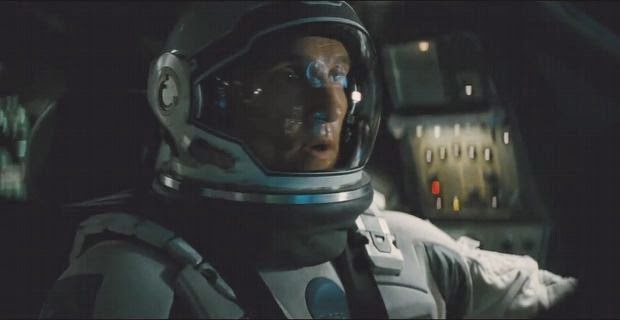
At its core, Interstellar is the story about a man trying to get home to his family, both in the literal and metaphorical sense. In the hands of Matthew McConaughey, who’s currently experiencing an astounding career renaissance, the scenes in which lead astronaut Cooper is either breaking away from his daughter as he’s leaving Earth or watching his kids rapidly grow up before his eyes on video logs transmitted to the spaceship, pack an undeniable emotional punch. If there’s anything keeping this space odyssey grounded, it’s McConaughey’s bravura performance, which inevitably overshadows all the supporting players, including fellow acting heavyweight in the making, Jessica Chastain.

Also worth mentioning is that, despite the afore-mentioned misgivings with the way he handles his subject matter, Christopher Nolan remains nonetheless the most gifted mainstream director currently working in Hollywood, proving once again that he’s just as adroit at delivering a monumental set-piece (superbly conveying the right balance of dread and excitement that one would feel at entering a black hole for the first time) or handling the more quietly powerful moments, such as the scene in which a stranded astronaut breaks down after seeing another human being for the first time in years.

But then Christopher’s studies on physics and relativity kick in again, resulting in a final act twist that is likely to confound casual viewers and infuriate astronomy students. It’s daring, it’s different, it’s definitely something new that we haven’t been exposed to before on the silver screen, but there will be some head scratching. Worst of all, it comes neatly bow-tied with a “love conquers all” message which is seriously out of place with all the scientific babble we’ve had to endure until this point.

Is Interstellar a bad film? Far from it, it would actually be nice to see more blockbusters with this much drive and originality. But the end product certainly doesn’t live up to the audience’s expectation and, quite possibly, the Nolans’ ambition.

3/5


Monday, 10 November 2014

Locke


Let’s be honest, watching a bloke drive down the M40 for an hour and a half hardly qualifies as high octane filmmaking. And yet, in the hands of screenwriter-turned director Stephen Knight, Locke turns out to be one of the must-see films of the year. There are no car chases or explosions here, just a quietly brilliant Tom Hardy making a series of fraught calls on what is set to be the worst night of his life. Hardy’s tender performance brings a minimalist but powerful screenplay to life, although Knight is guilty of indulging in what is rapidly becoming a big no no in Hollywood scripts, i.e. the heart-to-heart conversation with an imaginary character. Seriously, this needs to stop.

4/5

Thursday, 6 November 2014

Nightcrawler

Spare a thought for Jake Gyllenhaal, if you will. A professional child performer who has managed to hone his craft over the years, young Jake never seems to have earned the critical acclaim that has been bestowed on other actors of his generation. Just look at his Brokeback Mountain co-stars: Heath Ledger cemented his position as a Hollywood legend with a couple of stellar roles before his premature death, while Michelle Williams and Anne Hathaway have since established themselves as nomination bait during award seasons. And Gyllenhaal? Well, he went on to make Prince of Persia. Which puts things into perspective, doesn’t it?

What Nighcrawler represents is an opportunity for the erstwhile Donnie Darko to show critics and audiences what he’s truly capable of, and in Lou Bloom he has found an unlikely saviour. Isolated, introverted and emotionally detached, he’s a Los Angeleno hell-bent on getting hired and forging a career in today’s competitive market. The job doesn’t matter, nor does the sector, as long as it puts him on the map. When he comes across a TV crew filming the carnage caused by a highway accident, Lou finds his calling and decides to become a freelance video reporter. It’s not long before success goes to his head and he starts interfering with crime scenes in a bid to secure higher ratings.

It’s the perfect role for an up-and-coming actor to sink his teeth into and Gyllenhaal clearly relishes the opportunity. He goes through the traditional “Method” motions (weight loss, unappealing hair), but it’s in the delivery of his character’s unusual dialogue where he truly shines. With his unsettling propensity to speak in buzzwords and positive action verbs, Bloom sounds like he’s constantly giving a job interview – or hosting it, depending what side of the metaphorical table he is sitting at. “I've made up my mind to find a career that I can learn and grow into. Who am I? I'm a hard worker. I set high goals and I've been told that I'm persistent”, he says to a prospective employer at the beginning of the film, before delivering the already classic line “If you want to win the lottery, you have to make the money to buy a ticket”. Most of the times the lines will raise a few laughs, but there’s no denying that these are the warning signs for a sociopath. Either way, expect Lou Bloom quotes to appear on business students’ dorm walls in the very near future.

But while Gyllenhaal does an excellent job at bringing this 21st Century Travis Bickle to life, it would be a mistake to overlook Dan (brother of Tony) Gilroy’s dual role as director and screenwriter. By tackling a dark subject matter – the media’s exploitation of urban crime – the first time director manages to generate chills and thrills from the most controversial of scenarios, the key one being a gruesome domestic invasion accompanied by the jaded commentary of two news anchors. Of course the irony is that, by having us so engrossed in these scenes, Gilroy is making the audience complicit in the sensationalism he’s criticising. Also, he pulls off what must be the year’s messiest car chase and is all the better because of it.

With awards season just around the corner, is it worth pondering Nightcrawler’s chances at the 2015 Oscars? It’s probably just a waste of time, especially with so many biopics hovering around at the moment. Whether he gets nominated or not, it’s worth highlighting that Gyllenhaal’s performance is one of the best of the year and one that should finally prove his credentials as a serious actor. Move over Donnie, Lou is here to stay.


5/5 

The Judge


If there's one thing The Judge succeeds in, it's reminding us that there's more to Robert Downey Jr. than iron suits and deer stalkers. Here is a movie star that many forget was garnering serious acting kudos in the early ‘90s and in David Dobkin’s drama he puts his quick wit and outstanding improv skills to good use as a slick city lawyer who returns to his hometown to represent his estranged father (Robert Duvall), the titular judge, in a murder trial. It’s just a shame that the courtroom scenes are misguidedly overshadowed by the family drama, which often feels ham-fisted and rarely poignant. Not even the winning Duvall/Downey combo can save this from being a mistrial.

2/5

Wednesday, 15 October 2014

Gone Girl

Here’s the thing: it’s not as good as the book. There, it’s been said. Deal with it. Authored by Gillian Flynn and published in 2012 to widespread acclaim, Gone Girl is the story of a man being investigated for the disappearance of his wife and is easily one the greatest reads in recent memory. It is a novel that defies genre (“it’s a romantic crime thriller satire, duh”) and raises some very intriguing questions about the authenticity of married life. Narrated in the first person from His and Her point of view, it’s a text ripe with musings and deep-seated confessions that both men and women can relate to, but just might not admit to having with their other halves.

The inevitable downside is that these compelling streams of consciousness cannot be effectively reproduced on the big screen, no matter how many voiceovers try to make up for it. But then again, while Gillian Flynn’s Gone Girl may never get the perfect adaptation that all fans of the book may long for, David Fincher’s Gone Girl remains no doubt a film worth seeing.

Fincher has carved himself a career out of gloomy, twisted material (his most upbeat work may well be a Coca Cola advert from the early 90s) and Gone Girl’s shadier themes lend themselves well to his style of filmmaking. Coated in dark, sombre visuals, even white picket-fenced American suburbia feels like a haunting place in Fincher’s hands. Adding further obscurity to the proceedings is Trent Reznor’s otherworldly score, which makes for an unsettling acoustic experience with its unpredictable electronic staccatos.

More importantly, the one aspect of Flynn’s novel that Fincher manages to successfully translate to film is the theme of perception and how easily it can be distorted, whether it’s in a marriage or in modern day media. Characters’ images are continuously subverted in private and in public via scathing news reports and intimate revelations, putting the viewer’s sympathy to serious test throughout the plot. Some twists may be more predictable than others, but the tension and suspense never subside and will have you on the edge of your seat.

Come to think of it, never mind mass media exploitation and the politics of long term relationships – if there’s one controversial topic that Gone Girl helps address once and for all, it’s that Rosamund Pike should be as big a star as Rachel McAdams or Reese Witherspoon, two other blonde, likeable actresses in their mid-thirties with arguably less range than this English rose. Sure, Ben Affleck’s silhouette is on all the posters and he does a fine job as an average joe faced with incredible circumstances, but thanks to a bravura performance that oscillates between vulnerable and disturbing, Pike steals the film from under his nose and walks away with it until she’s gone, girl. Sorry, had to be done.


4/5

Saturday, 11 October 2014

Pasolini

Pasolini is the kind of film that gives arthouse cinema a bad name. Focusing on the last day in the life of the enigmatic auteur and directed by Bad Lieutenant’s Abel Ferrara, it mistakes pretentiousness for ambition and incoherence for intellect. Willem Dafoe is undeniably magnetic as the Italian filmmaker, but it would’ve been nice to drop some of the romping and instead dedicate a bit more time to exploring his character. You could argue it’s a case of two artistic visions jostling for supremacy – but if the film needs to disappear up someone’s ass, it might as well be Pasolini’s, rather than Ferrara’s.


1/5

Wednesday, 17 September 2014

Top 5 Spider-Man films


5) Spider-Man 3

Seven years later and the Saturday Night Fever dance still haunts the dreams of Spidey fanboys around the world. But the truth is, while it would be easy to direct all our frustrations to Peter Parker’s ill-judged emo phase, there’s plenty of other stuff wrong with Spider-Man 3 as well. Characters are spectacularly miscast (who better to play the bitter, physically imposing Eddie Brock from the comics than the chipper, skinny guy from That 70s Show?), emotional scenes turn into unintentionally hilarious ones (MJ and Peter’s break-up in Central Park) and three villains jostle for position as the main big bad, with none of them coming on top. Most upsetting of all is the complete mishandling of Venom, arguably the wall-crawler’s most popular antagonist, who gets a grand total of 6 minutes of screen time. Shame on you, Sam Raimi. Shame on you.


4) The Amazing Spider-Man 2

Despite a surprisingly aggressive marketing campaign in the months leading to its release, it wouldn’t be a stretch to say TASM2 failed to live up to its own hype. In fact, it is plagued by the same flaws that made Spider-Man 3 such a challenging watch. A disjointed narrative suggests the editing process can’t have been a happy one and once again too many villains spoil the proverbial broth, with Jamie Foxx thinking he’s starring in a superhero film from the Joel Schumacher era (i.e. camp and prone to punning). Still, there are a few saving graces that ensure this isn’t a complete train wreck. Hans Zimmer delivers a sumptuous score that is finally worthy of Spider-Man’s stature and doesn’t sound like something out of Batman (Raimi’s trilogy) or Titanic (The Amazing Spider-Man); the most thrilling scene in the film is not an action set-piece, but a suspenseful confrontation in Times Square, as Spidey hopelessly tries to calm down an Electro that’s on the brink of exploding; and Andrew Garfield and Emma Stone’s romantic banter is still bang on the money.


3) The Amazing Spider-Man

Yes, it was the reboot that nobody wanted (yet) and sure, the first half feels like a re-tread of what came before in Sam Raimi’s still wonderful first instalment from 2002, but look past these minor issues and there’s a lot going for The Amazing Spider-Man. Combining themes and key elements from both the classic and Ultimate comic book runs, here was a Spidey film that was surprisingly even more faithful to its source material than the Raimi movies and that had the perfect Spider-Man in the form of Andrew Garfield. A far more versatile actor than Tobey Maguire, some might argue that Garfield’s Peter Parker is a little too cool to begin with (it’s the Twilight hair, apparently), but what can’t be denied is that he effortlessly nails the character’s social displacement and sardonic humour. Furthermore, Marc Webb proved he knew how to portray a quirky couple on-screen with (500) Days of Summer and he pulls off the same trick with Garfield and Emma Stone, who are a joy to watch whether they are playfully bickering or blissfully pining for each other.


2) Spider-Man

It’s very difficult to review Sam Raimi’s franchise starter without being overcome with a fuzzy sense of nostalgia. After all, this movie hails from a time when audiences were not accustomed to superhero blockbusters (X-Men may have arrived 2 years earlier, but it felt more like an outlandish Sci-Fi movie) and no one quite knew what to expect from a Spider-Man film. And while now it does feel dated in places (the web-slinging looks a bit stiff and the fight sequences a little too choreographed), Spider-Man has lost none of its charm. Tobey Maguire may not be a particularly adroit performer, but his boyish demeanour still make him the most beloved Spidey out there and Kirsten Dunst is utterly believable as the girl next door we all secretly want to go out with. Much has been made over the years of the villain’s Toys R Us costume but, truth be told, it’s a far better proposition than James Franco’s snow-boarding gear from Spider-Man 3 and, with that face and cackling laugh, Willem Dafoe simply is the Green Goblin. And then there’s THAT kiss, quite possibly the most romantic moment in the comic book movie genre and the moment teenage boys realised Spider-Man could make a brilliant fist date movie. Make no mistake, Iron Man fans and Guardians groupies… this is where it all began.


1) Spider-Man 2

Marvel Studios have produced their fair share of top notch films since Iron Man in 2008, but hardly any of them can hold a candle to Spider-Man 2, one of the rare instances in which the sequel truly is better than the original in almost every aspect. This is Spider-Man retold as a Byronic hero (hence the poetry references), a romantic character separated from the woman he loves by his own secrets and unfaltering commitment to justice… simply put, this is the one comic book flick where you really want the hero to get the girl at the end. There’s plenty of angst, anguish and heartache but none feel forced or out place, especially as some of Peter’s pains stem from more pedestrian (and therefore relatable) challenges, like making the rent or holding down a job. Adding further pathos to the proceedings is Alfred Molina’s Doc Ock, the franchise’s standout villain, with a fully-developed arc mirroring that of the protagonist. The third act fight scene set on a moving train still remains the action sequence to beat for all comic book movies – see James Mangold try to recreate it in The Wolverine, with decidedly average results. And finally, whenever things seem to get a little too gloomy, you can always count on J.K. Simmons’ J. Jonah Jameson (an impeccable comedic creation sorely missed from the reboot and its sequel) to alleviate the mood with a well-timed quip, often delivered at the top of his voice. Popcorn movies – or rather, Spider-Man movies – don’t get much better than this.